

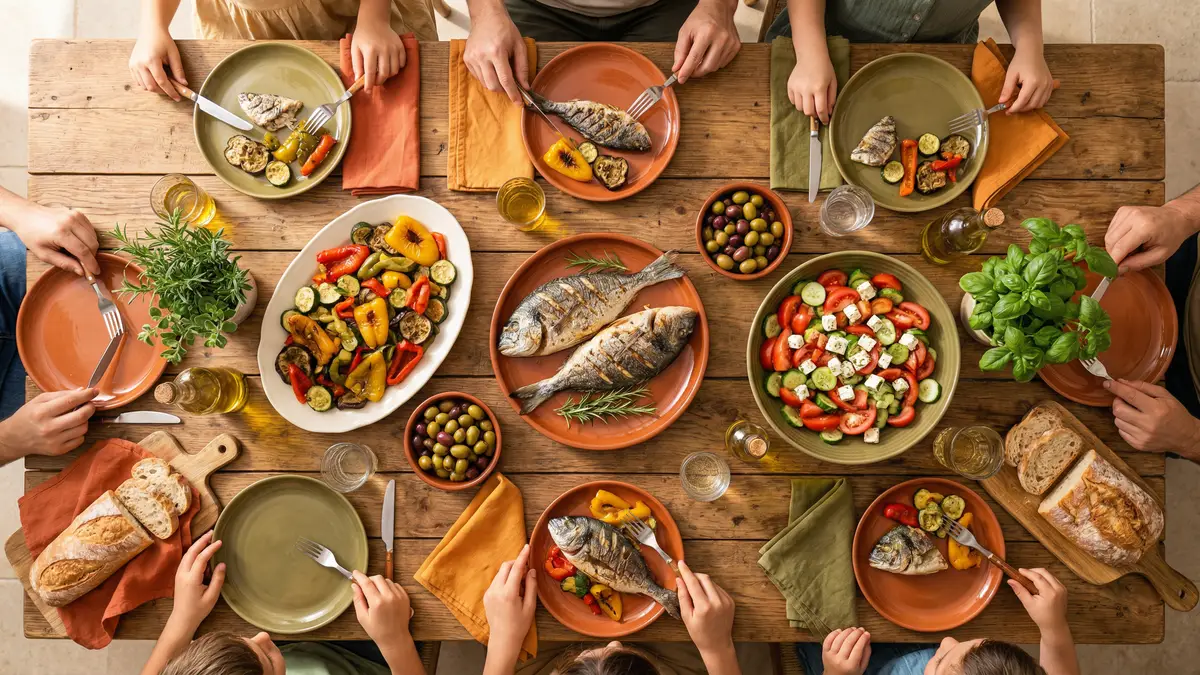

For many UK families, the idea of eating a Mediterranean diet sounds healthier than it sounds practical.
Olive oil, fresh fish, vegetables, wholegrains, nuts and colourful salads all feature heavily in descriptions of the diet. But families also have school lunches to prepare, busy weekdays to manage, different tastes to accommodate and grocery bills to watch.
The good news is that following a Mediterranean-style eating pattern does not require a complete change of cuisine or an expensive specialist food shop.
The principles are surprisingly close to the UK’s own healthy-eating advice. The NHS Eatwell Guide recommends eating plenty of fruit and vegetables, basing meals on higher-fibre starchy foods, including beans, pulses, fish, eggs and other protein foods, choosing unsaturated oils and limiting foods high in fat, salt and sugar.
For UK families, the more useful question is therefore not whether to copy a traditional Mediterranean menu.
It is how to apply those principles to everyday British family life.
Table of Contents
- What is the Mediterranean diet?
- Is the Mediterranean diet suitable for UK families?
- Mediterranean diet vs the NHS Eatwell Guide
- What foods are included?
- Mediterranean diet food groups
- How much fish should families eat?
- Can children follow a Mediterranean diet?
- What about toddlers?
- Can children eat nuts?
- Mediterranean eating on a budget
- Are frozen and tinned foods suitable?
- What about olive oil?
- Does the Mediterranean diet include meat?
- Is pasta allowed?
- A simple seven-day family meal framework
- Mediterranean diet and health
- What recent UK research says
- Mediterranean eating and cultural diversity
- Common mistakes to avoid
- Key takeaways
What Is the Mediterranean Diet?
The Mediterranean diet is better understood as an eating pattern than a strict diet.
Traditional Mediterranean-style eating places considerable emphasis on plant foods, including vegetables, fruit, pulses, wholegrains, nuts and seeds. Olive oil is a common source of fat, while fish and seafood are regularly included. Dairy, eggs and poultry can also feature, while red and processed meat generally play a smaller role.
The British Dietetic Association notes that the Mediterranean pattern has been associated with cardiovascular and other health benefits, while also stressing that it is not the only healthy way to eat.
That distinction matters.
A family does not have to eat Greek, Italian or Spanish food every day to follow Mediterranean-style principles.
A vegetable curry made with lentils, a bean chilli served with wholegrain rice, grilled fish with potatoes and vegetables, or a wholemeal sandwich with salad can all fit a healthy dietary pattern without being traditional Mediterranean dishes.
Is the Mediterranean Diet Suitable for UK Families?
Yes, Mediterranean-style principles can be adapted to family eating in the UK.
In fact, many of the recommendations overlap with the NHS Eatwell Guide.
The NHS advises people to get the balance of their diet right over a day or even a week rather than trying to achieve a perfect balance at every individual meal.
That makes the approach particularly useful for families.
A child might have porridge and fruit for breakfast, a school lunch containing wholegrain bread and vegetables, yoghurt and fruit as a snack, and a family dinner containing pasta, vegetables and beans.
The aim is not perfection.
The aim is the overall pattern.
Mediterranean Diet vs the NHS Eatwell Guide
The two approaches are not competing systems.
| Mediterranean-style principle | NHS Eatwell Guide |
|---|---|
| Plenty of vegetables | Fruit and vegetables should make up just over a third of food intake |
| Fruit regularly | At least five portions of fruit and vegetables a day |
| Beans and pulses | Included within the protein-food group |
| Wholegrains | Choose higher-fibre starchy carbohydrates |
| Fish | Include fish as part of a balanced diet |
| Unsaturated oils | Choose unsaturated oils and spreads in small amounts |
| Moderate dairy | Include some dairy or alternatives |
| Less red and processed meat | Eat less processed meat and moderate meat consumption |
| Limit sugary foods | Foods high in fat, salt and sugar should be eaten less often |
| Water | NHS recommends regular fluid intake |
The NHS specifically says fruit and vegetables can be fresh, frozen, canned, dried or juiced.
That is useful for families because Mediterranean-style eating does not have to mean buying only fresh produce.
What Foods Are Included in a Mediterranean Diet?
A practical family version can be built around the following foods.
Vegetables
Examples include:
- tomatoes
- peppers
- courgettes
- aubergines
- onions
- carrots
- broccoli
- spinach
- cabbage
- cauliflower
- peas
- green beans
There is no requirement for vegetables to be Mediterranean varieties.
British-grown vegetables can form a substantial part of family meals.
Fruit
Useful choices include:
- apples
- bananas
- oranges
- pears
- berries
- grapes
- peaches
- plums
- seasonal fruit
Fresh, frozen and appropriately stored fruit can all be useful.
Beans and pulses
Examples include:
- chickpeas
- lentils
- kidney beans
- cannellini beans
- butter beans
- black beans
- peas
These foods can be particularly useful for families because they can be added to soups, stews, curries, salads, pasta sauces and wraps.
Wholegrains
Options include:
- wholemeal bread
- wholewheat pasta
- brown rice
- oats
- wholegrain cereals
- barley
- higher-fibre wraps
The NHS recommends basing meals on higher-fibre starchy carbohydrates.
Fish
Examples include:
- salmon
- sardines
- mackerel
- trout
- herring
- tuna
- white fish
Fish is an important part of the Mediterranean pattern, but UK families should follow NHS guidance concerning portions and fish species.
Nuts and seeds
Examples include:
- almonds
- walnuts
- hazelnuts
- pumpkin seeds
- sunflower seeds
- chia seeds
For young children, however, whole nuts present a choking risk and require particular care.
Unsaturated oils
Olive oil is traditional, but it is not the only suitable option.
The NHS recommends choosing unsaturated oils and spreads in small amounts.
Rapeseed oil can therefore have a place in a UK kitchen too.
How Much Fish Should a UK Family Eat?
NHS guidance recommends that people eat at least two portions of fish a week, including one portion of oily fish.
For adults, a portion is approximately 140g of cooked fish.
Oily fish includes:
- salmon
- sardines
- mackerel
- trout
- herring
Fish consumption needs more careful planning for children because of pollutants that can accumulate in some fish.
The NHS recommends that children have at least one portion of oily fish a week.
Boys should have no more than four portions of oily fish per week, while girls should have no more than two.
Children under 16 should not eat shark, swordfish or marlin because of their mercury content.
The message for parents is straightforward: fish can be an important part of a healthy family diet, but more is not automatically better.
Can Children Follow a Mediterranean Diet?
Children can eat many of the foods associated with Mediterranean-style eating.
However, children have different nutritional requirements from adults, so parents should avoid putting children on restrictive adult diets.
The NHS states that young children need protein and iron for growth and development.
Suitable protein foods include:
- beans
- pulses
- fish
- eggs
- tofu
- hummus
- meat
- other soya products.
For children, the focus should therefore be on variety, adequate energy and nutrients, rather than calorie restriction.
A family meal can usually be adapted rather than preparing an entirely separate dish for children.
For example:
Adults: wholewheat pasta with tomato sauce, beans, vegetables and a small amount of cheese.
Children: the same meal, with portions and textures adjusted to their age and eating ability.
What About Toddlers?
The NHS Eatwell Guide is designed for the general population aged two and over.
Children under two have different nutritional needs.
The NHS says young children need protein and iron for growth and development and recommends foods such as beans, chickpeas, lentils, tofu, fish, eggs and meat.
Parents should therefore avoid treating a Mediterranean diet as a weight-loss programme for young children.
For toddlers, the priority is nutritious food, appropriate textures, sufficient energy and safe preparation.
Can Children Eat Nuts?
Nuts can be nutritious, but whole nuts should not be given to children under five because of choking risk.
The NHS advises that whole nuts, including peanuts, should not be given to under-fives.
Parents can use appropriately prepared forms such as smooth nut butter or finely ground nuts when developmentally suitable.
Families should also follow NHS guidance on introducing potential allergens.
This is an area where a generic Mediterranean diet article can easily become unsafe if it treats children’s diets as simply smaller versions of adult diets.
How to Follow a Mediterranean Diet on a Budget
Mediterranean eating does not need to mean premium ingredients.
Some of the most useful foods are inexpensive staples.
Budget-friendly Mediterranean-style foods
- oats
- potatoes
- wholemeal bread
- brown rice
- wholewheat pasta
- dried lentils
- tinned lentils
- tinned chickpeas
- tinned beans
- tinned tomatoes
- frozen vegetables
- seasonal fruit
- eggs
- plain yoghurt
- frozen fish
- canned sardines
- canned mackerel
This matters in Britain because food affordability remains a significant issue.
Defra’s Family Food FYE 2024 data recorded average household expenditure of £32.30 per person per week on household food and non-alcoholic drinks.
Government data also show that lower-income households devote a larger proportion of their expenditure to food. The government’s 2026 Food Statistics in Your Pocket reports that in FYE 2025 the lowest 20% of households by disposable equivalised income spent 15.2% of expenditure on household food and non-alcoholic drinks, compared with 7.9% for the highest 20%.
That is why affordability should be treated as part of healthy-eating advice rather than an afterthought.
Are Frozen and Tinned Foods Suitable?
Yes.
The NHS explicitly recognises fresh, frozen and canned fruit and vegetables as ways of reaching five portions a day.
Frozen vegetables can be particularly useful for families because they can be stored for longer and used when needed.
Tinned beans and pulses can also be convenient.
Where appropriate, parents can choose lower-salt products or drain and rinse canned foods.
Tinned tomatoes are another useful base for family cooking.
A simple tomato sauce can be combined with:
- lentils
- chickpeas
- beans
- vegetables
- fish
- wholewheat pasta
This can produce several different family meals from relatively similar ingredients.
Do You Need Extra-Virgin Olive Oil?
No single oil is mandatory.
Olive oil is strongly associated with Mediterranean cuisine and is a useful source of unsaturated fat.
However, UK healthy-eating guidance focuses on unsaturated oils and spreads, rather than requiring people to buy one specific oil.
This means a UK household can use olive oil where it suits the dish and budget while also using other unsaturated oils.
Food Future has previously examined the practical substitution of olive oil in cooking, including the cost considerations involved.
The important point is that oil is energy-dense, so even healthier oils should be used in sensible quantities.
Does the Mediterranean Diet Include Meat?
Yes, but meat is generally less central than plant foods and fish.
A Mediterranean-style family diet can include:
- chicken
- turkey
- lean meat
- eggs
- fish
Red and processed meat should not dominate the diet.
The UK approach is consistent with reducing reliance on meat while using a variety of other protein sources.
Beans, chickpeas and lentils can be used in place of some meat in dishes such as:
- chilli
- pasta sauces
- stews
- soups
- wraps
- salads
- traybakes
Is Pasta Allowed on a Mediterranean Diet?
Yes.
Pasta is not excluded from Mediterranean-style eating.
The key is the overall meal and dietary pattern.
A family pasta meal can become more Mediterranean-style by combining wholewheat pasta with:
- tomatoes
- vegetables
- beans or lentils
- fish
- olive oil
- herbs
- a modest amount of cheese
Portion size and the rest of the meal still matter.
The NHS specifically recommends higher-fibre starchy carbohydrates such as wholegrain versions where possible.
A Simple Seven-Day Mediterranean-Style Family Framework
This is a meal framework, not a prescribed diet or medical meal plan.
| Day | Breakfast | Lunch | Evening meal |
|---|---|---|---|
| Monday | Porridge with fruit | Wholemeal sandwich, salad and yoghurt | Lentil and vegetable pasta |
| Tuesday | Wholegrain cereal and fruit | Chickpea and vegetable wrap | Salmon, potatoes and vegetables |
| Wednesday | Wholemeal toast, egg and fruit | Bean and vegetable soup | Chicken, brown rice and roasted vegetables |
| Thursday | Porridge and berries | Hummus, wholemeal pitta and vegetables | Vegetable and chickpea curry |
| Friday | Yoghurt, oats and fruit | Tuna and salad wholemeal sandwich | Wholewheat pasta with tomato, vegetables and beans |
| Saturday | Eggs, wholemeal toast and fruit | Leftover vegetable and bean bowl | Grilled fish, potatoes and vegetables |
| Sunday | Oats, fruit and yoghurt | Vegetable soup with wholemeal bread | Roast chicken, vegetables and potatoes |
Families can swap ingredients according to:
- allergies
- cultural preferences
- dietary requirements
- supermarket prices
- seasonality
- availability
- children’s preferences.
How to Build a Mediterranean-Style Family Plate
A simple approach is to think about the components rather than following a rigid recipe.
1. Start with vegetables
Add one or more vegetables to the meal.
2. Add a fibre-rich carbohydrate
Choose potatoes, wholegrain bread, brown rice, wholewheat pasta or another higher-fibre option.
3. Add protein
Use beans, lentils, chickpeas, fish, eggs, poultry, tofu or another suitable protein source.
4. Add a small amount of unsaturated fat
This might be olive oil, rapeseed oil, nuts, seeds or another suitable source.
5. Add fruit or vegetables elsewhere in the day
The NHS recommends at least five portions of fruit and vegetables daily.
The balance does not need to be perfect at every meal.
What Does the UK Data Tell Us?
The latest Defra Family Food data show that some foods central to Mediterranean-style eating are not being purchased in greater quantities.
In FYE 2024, household purchases of vegetables excluding potatoes fell by 5.5% compared with FYE 2023.
Fish purchases fell by 4.8%.
Fruit purchases increased by 1.3%.
Meat purchases fell by 1.1%.
The figures do not show why individual households changed their purchasing behaviour.
However, they demonstrate why healthy eating advice needs to consider real shopping habits rather than simply describing an ideal menu.
Fruit and Vegetables Remain a Major UK Challenge
Government monitoring also shows that eating enough fruit and vegetables remains difficult for many people.
In England in 2023/24, 31.3% of adults reported eating at least five portions of fruit and vegetables a day.
There was a substantial socioeconomic difference: the proportion was 38.6% in the least deprived areas compared with 20.0% in the most deprived areas.
That does not mean the Mediterranean diet is a solution to socioeconomic inequality.
It does show why practical and affordable ways of increasing fruit and vegetable intake matter.
What Does Recent Research Say About the Mediterranean Diet?
The scientific evidence around Mediterranean-style eating is extensive, but it needs to be interpreted carefully.
A 2025 UK Biobank study examined 131,209 participants aged 40 to 69 who had no dementia at baseline.
Over a median follow-up of 13.5 years, 1,453 dementia cases were identified.
Higher adherence to the Mediterranean diet was associated with lower dementia risk, with the study reporting a hazard ratio of 0.79 for the highest versus lower adherence category under its MEDAS analysis.
This was an observational cohort study.
It therefore demonstrates an association, not proof that following a Mediterranean diet prevents dementia.
Another UK Biobank study published in 2025 also found associations between higher adherence to several healthy dietary patterns and lower dementia risk. The Mediterranean Diet Score produced the strongest association in that particular analysis.
Again, the findings should not be presented as proof of cause and effect.
What About Brain Health?
UK research has also investigated the relationship between dietary patterns and brain structure.
A UK Biobank study involving 26,466 participants found that higher MIND diet adherence was associated with larger volumes in several brain regions and lower white-matter hyperintensities.
A separate 2025 UK Biobank study examined the relationship between Mediterranean-style and other healthy dietary patterns and dementia risk.
These studies add to the evidence base but do not mean that eating a particular food or diet guarantees protection from dementia.
For a family guide, the more appropriate conclusion is that overall dietary quality matters over the long term.
The Mediterranean Diet Is Not the Only Healthy Diet
This point deserves emphasis.
The British Dietetic Association has specifically addressed the tendency to portray the Mediterranean diet as the single “best” dietary pattern.
Registered Dietitian Tai Ibitoye argues that healthy principles can also be found in traditional African, Arabic, Asian and Caribbean diets.
That is particularly relevant in the UK.
A family does not need to abandon:
- curries
- dhal
- chapatti
- rice
- beans
- Caribbean dishes
- Middle Eastern foods
- African dishes
- East Asian meals
to eat healthily.
Instead, families can apply similar principles within their existing cuisine.
For example, a lentil dhal with vegetables and wholegrain roti can fit many of the same nutritional principles.
So can a vegetable-rich stir-fry with tofu and brown rice.
The label matters less than the overall dietary pattern.
How to Make Mediterranean Eating Work for Busy Families
The biggest barrier is often not nutrition.
It is time.
A few practical habits can make the approach easier.
Keep a pulse cupboard
Store:
- chickpeas
- kidney beans
- lentils
- cannellini beans
- tinned tomatoes
Keep vegetables available
Use a mixture of fresh and frozen vegetables.
Cook once, use twice
A large vegetable-and-bean sauce can become:
- pasta sauce on Monday
- a filling for wraps on Tuesday
- soup later in the week.
Keep simple fish options available
Frozen fish and canned oily fish can make fish meals easier.
Make family meals adaptable
Serve components separately when children are selective eaters.
For example:
pasta + tomato sauce + vegetables + grated cheese.
This lets family members combine the foods they prefer without creating completely separate meals.
Common Mistakes to Avoid
Mistake 1: Thinking Mediterranean means expensive
It does not.
Beans, lentils, oats, potatoes, wholemeal bread and frozen vegetables can all support a healthy eating pattern.
Mistake 2: Thinking every meal needs olive oil
It does not.
The NHS recommendation is to choose unsaturated oils and spreads in small amounts.
Mistake 3: Turning it into a children’s weight-loss diet
Children have different nutritional needs.
The focus should be balanced nutrition and healthy growth, not restrictive dieting.
Mistake 4: Ignoring fish limits
Children have specific guidance around oily fish and certain high-mercury fish.
Mistake 5: Giving whole nuts to young children
Whole nuts should not be given to children under five because of choking risk.
Mistake 6: Believing Mediterranean means pasta, pizza and wine
Those stereotypes do not accurately represent the dietary pattern.
Wine is not a requirement for healthy Mediterranean-style eating.
Mistake 7: Treating one study as proof
Much of the long-term evidence comes from observational research.
Associations should not automatically be presented as causal effects.
Can the Mediterranean Diet Help UK Families Eat More Healthily?
Potentially, because its core principles are compatible with established UK healthy-eating guidance.
But there is no need to treat the Mediterranean diet as a magic formula.
The strongest approach is to build meals around:
- vegetables
- fruit
- wholegrains
- pulses
- fish
- appropriate protein
- unsaturated fats
- moderate dairy or alternatives
while limiting foods high in saturated fat, salt and free sugars.
That is already close to the central message of the NHS Eatwell Guide.
Key Takeaways
- The Mediterranean diet is an eating pattern rather than a rigid diet.
- Its principles overlap substantially with the NHS Eatwell Guide.
- UK families do not need specialist imported foods.
- Beans, lentils, chickpeas and wholegrains can form inexpensive staples.
- Frozen and canned fruit and vegetables can contribute to a healthy diet.
- Adults should aim for at least five portions of fruit and vegetables each day.
- NHS guidance recommends at least two portions of fish a week, including one oily fish.
- Children have specific fish and mercury guidance.
- Whole nuts should not be given to children under five.
- Toddlers have different nutritional requirements from adults.
- Olive oil is useful but is not the only acceptable unsaturated oil.
- Mediterranean-style eating can be adapted to British and other cultural cuisines.
- Recent UK Biobank research has found associations between Mediterranean-style eating and lower dementia risk.
- Observational research does not prove that the diet prevents dementia.
- Affordability needs to be considered when recommending healthy food to UK families.
- A healthy dietary pattern matters more than copying a particular country’s cuisine.
Expert Insight
The most useful way for a UK family to approach the Mediterranean diet is not as a list of exotic ingredients but as a set of everyday eating principles.
The British Dietetic Association’s guidance is particularly relevant here: Mediterranean-style eating can be healthy, but it is not the only healthy dietary pattern.
That makes the approach more inclusive.
A British family can eat Mediterranean-style meals while still enjoying familiar foods and recipes from other cultures.
The practical priority should be increasing the overall presence of vegetables, fruit, pulses, wholegrains and suitable protein foods while reducing reliance on foods high in saturated fat, salt and free sugars.
For families under financial pressure, this also means using the freezer and store cupboard intelligently.
The healthiest shopping list is not necessarily the most expensive one.
Final Conclusion
A Mediterranean diet can work well for UK families because its underlying principles are already closely aligned with the NHS approach to balanced eating.
The biggest advantage is its flexibility.
Families can use vegetables from the freezer, beans from the cupboard, wholemeal bread, oats, potatoes, seasonal fruit, eggs, fish and other everyday foods to build meals around the same broad principles.
The evidence supporting Mediterranean-style dietary patterns is substantial, including recent UK Biobank research. However, the science should be communicated accurately: associations between dietary patterns and health outcomes do not automatically prove that the diet itself causes those outcomes.
For parents, the most important lesson is therefore not to chase a perfect Mediterranean menu.
It is to build a varied family diet that makes vegetables, fruit, wholegrains, pulses, fish and other nutritious foods part of everyday eating.
That approach is practical, recognisable and much closer to real life in a UK kitchen.
Frequently Asked Questions
1. What is the Mediterranean diet?
The Mediterranean diet is a dietary pattern based largely on vegetables, fruit, pulses, wholegrains, nuts, seeds, fish and unsaturated oils, with smaller amounts of red and processed meat and foods high in saturated fat, salt and free sugars.
2. Is the Mediterranean diet suitable for UK families?
Yes. Its main principles overlap substantially with the NHS Eatwell Guide and can be adapted using ordinary UK supermarket foods.
3. Can children eat a Mediterranean diet?
Children can eat many foods associated with Mediterranean-style eating, but they have different nutritional requirements from adults. The focus should be balanced nutrition, growth and variety rather than restrictive dieting.
4. How much fish should children eat?
The NHS recommends that children have at least one portion of oily fish each week. Boys should have no more than four portions of oily fish weekly and girls no more than two.
5. Can toddlers eat Mediterranean-style food?
Yes, many Mediterranean-style foods can be suitable for young children. However, children under two have different nutritional requirements and should not simply follow an adult diet.
6. Can children eat nuts?
Whole nuts should not be given to children under five because of choking risk. Appropriately prepared forms such as smooth nut butter or finely ground nuts can be used when suitable.
7. Is the Mediterranean diet expensive?
It does not have to be. Lentils, beans, chickpeas, oats, potatoes, wholemeal bread, frozen vegetables and tinned tomatoes can provide relatively inexpensive building blocks for family meals.
8. Do I have to use olive oil?
No. Olive oil is commonly used in Mediterranean cuisine, but UK healthy-eating guidance recommends choosing unsaturated oils and spreads in small amounts rather than requiring one specific oil.
9. Is pasta allowed on the Mediterranean diet?
Yes. Pasta can form part of a Mediterranean-style meal. Wholewheat pasta combined with vegetables, pulses, fish or another suitable protein can fit the overall pattern.
10. Can I use frozen vegetables?
Yes. The NHS states that fruit and vegetables can be fresh, frozen or canned and still contribute towards the recommended five portions a day.
11. Does the Mediterranean diet include meat?
Yes, but red and processed meat generally play a smaller role than vegetables, pulses and fish. Chicken, eggs and other protein foods can also be included.
12. Is the Mediterranean diet better than the Eatwell Guide?
The two should not be treated as competing diets. Many of the Mediterranean diet’s core principles overlap with the NHS Eatwell Guide. The Mediterranean pattern is one healthy dietary model rather than the only healthy way to eat.
13. Can a vegetarian family follow a Mediterranean-style diet?
Yes. Beans, lentils, chickpeas, tofu, eggs, dairy or suitable alternatives, nuts and seeds can provide a variety of protein sources.
14. Can a family follow a Mediterranean diet using British food?
Yes. The principles can be applied to British and other cuisines. There is no requirement to eat traditional Mediterranean recipes.
15. Does the Mediterranean diet prevent dementia?
It should not be described as a proven dementia-prevention treatment. Recent UK Biobank studies have found associations between greater adherence to Mediterranean-style dietary patterns and lower dementia risk, but these observational findings do not establish that the diet itself causes the reduction.

