

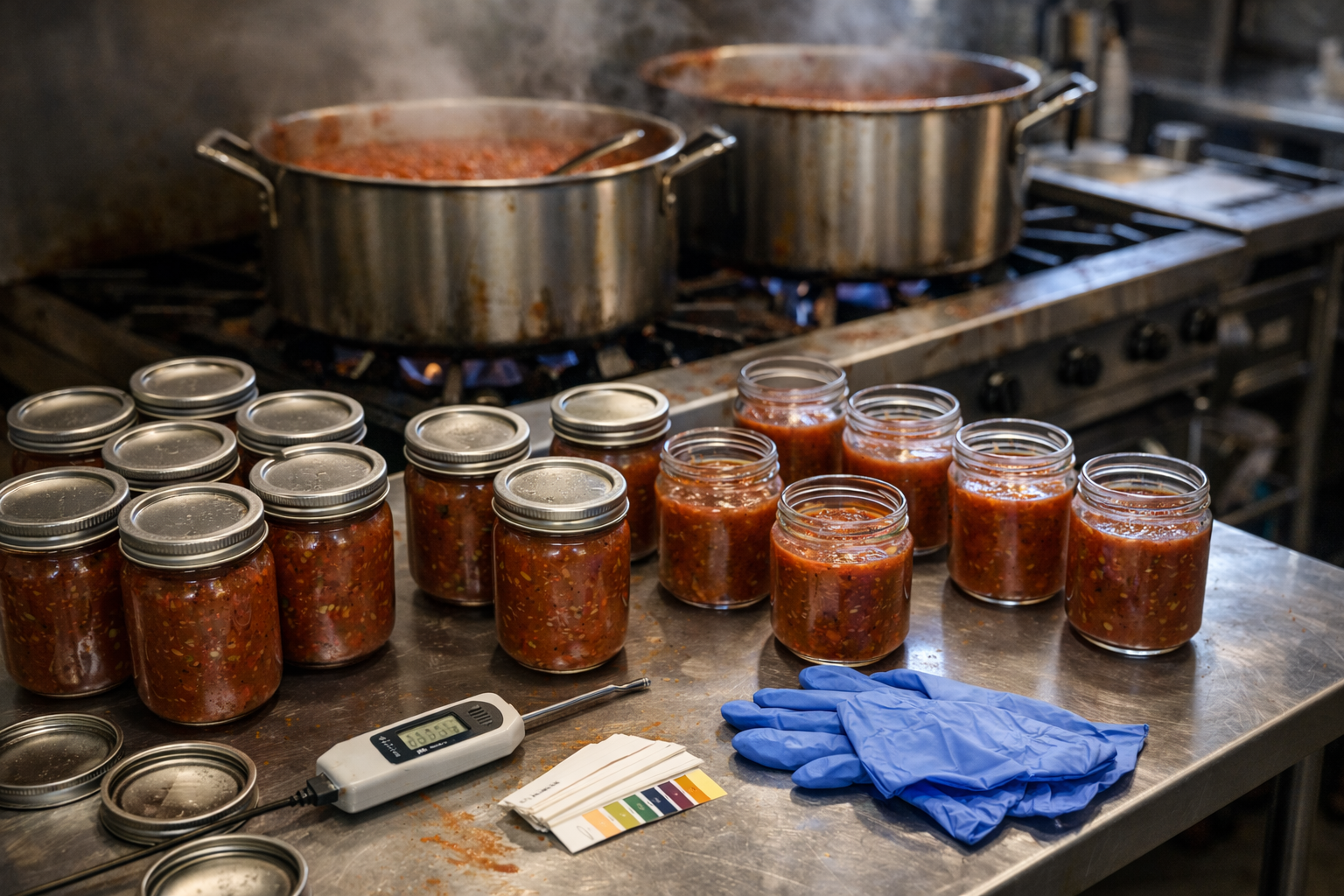

Most salsa problems don’t start with the recipe.
They start after the kettle is turned off.
Small-batch salsa producers obsess over ingredient sourcing, flavor balance, and heat level – then assume the rest is just execution. That assumption is the fastest way to inconsistent jars, shortened shelf life, and quiet retail rejection.
This article breaks down the critical failure points between cooking and shelf, where small-batch salsa producers unintentionally lose control of texture, safety, and consistency. If you make salsa for farmers’ markets, regional retail, or early-stage commercial distribution, this is the part of the process you can’t afford to ignore.
Why “Small-Batch” Is Not a Safety Net
Small-batch production feels controllable. Fewer jars. More hands-on oversight. Shorter timelines.
In reality, small-batch systems often lack the controls that larger operations rely on:
- No standardized transfer steps
- Inconsistent holding times
- Manual filling and sealing
- Variable sanitation between runs
These gaps don’t always cause immediate failure – but they compound over time.
Failure Point #1: Post-Cook Holding Time (The Invisible Risk)
What Happens After Cooking Matters More Than Cooking
Once salsa leaves the kettle, the clock starts ticking.
Common small-batch issues include:
- Letting product sit too long before filling
- Inconsistent cooling rates
- Partial reheating between fills
These practices create temperature gradients – warm pockets that encourage microbial activity even in acidified products.
According to guidance from the U.S. Food and Drug Administration, time–temperature control is just as critical after cooking as during it, especially for acidified foods.
Small producers often assume acidity alone is protection. It isn’t.
Failure Point #2: Mixing Fatigue and Ingredient Drift
Small Batches Still Separate
Salsa is a heterogeneous product. Solids begin settling the moment agitation stops.
In small-batch environments:
- Mixing is often manual or intermittent
- Agitation stops during filling
- Batches are topped off mid-run
This leads to:
- Early jars being chunk-heavy
- Later jars becoming watery
- Visible inconsistency across the same batch
Consumers notice. Retail buyers notice faster.
Failure Point #3: pH Consistency Is Assumed, Not Verified
Acidification Isn’t Uniform by Default
Even when a recipe is lab-tested, small-batch execution introduces variability:
- Uneven acid distribution
- Ingredient moisture differences
- Incomplete mixing after acid addition
Without continuous verification, producers may unknowingly ship jars outside safe pH limits.
The Institute of Food Technologists has published extensively on how heterogeneous foods are especially vulnerable to micro-environment pH variation – meaning one spoonful can differ from the next.
Testing one jar per batch is not enough.
Failure Point #4: Manual Filling Creates Compound Errors
Ladles, Funnels, and Gravity Are Not Neutral
Manual filling feels artisanal. It is also one of the highest-risk steps in salsa production.
Problems introduced during manual filling:
- Inconsistent fill weights
- Air entrainment
- Splash contamination
- Uneven solid-to-liquid ratios
Each jar becomes a unique outcome instead of a controlled unit.
This is often the point where producers begin researching commercial salsa filling solutions – not to “scale,” but to stabilize what already works. At that stage, the machine isn’t a growth tool; it’s a consistency tool.
That distinction matters.
Failure Point #5: Oxygen Exposure You Can’t See
Oxidation Happens Before the Lid Goes On
Fresh salsa degrades quickly when exposed to oxygen:
- Color dulls
- Flavor flattens
- Enzymatic activity accelerates
Manual workflows expose product repeatedly:
- Pouring
- Transferring
- Pausing mid-fill
- Delayed sealing
Research summarized in food packaging journals consistently shows that oxygen exposure during filling has a measurable impact on shelf life – sometimes more than formulation changes.
Small-batch producers rarely measure this. They feel it later, through returns and complaints.
Failure Point #6: Sealing Is Treated as a Final Step (ItIsn’t)
A Lid Is Not a Seal
Improper sealing is one of the most common causes of early failure:
- Inconsistent torque
- Product on the rim
- Misaligned lids
- Inadequate headspace
These issues don’t always cause leaks. Often, they cause slow ingress of oxygen and contaminants, shortening shelf life without obvious signs.
Retailers may not detect this immediately. Consumers will.
Failure Point #7: Sanitation Gaps Between Batches
Cleaning Is Not the Same as Sanitizing
Small-batch environments frequently reuse:
- Utensils
- Fill stations
- Work surfaces
Without standardized cleaning-in-process routines, microbial load increases incrementally with each batch.
This doesn’t show up on day one. It shows up weeks later – often blamed on “bad ingredients” or “transport issues” instead of process design.
Why These Failures Stay Hidden Until It’s Too Late
The most dangerous thing about these breakdowns is that they:
- Don’t ruin every jar
- Don’t happen every time
- Don’t trigger immediate safety alarms
Instead, they create statistical inconsistency – the hardest problem to diagnose after products are already in the market.
By the time patterns emerge:
- Brand trust is damaged
- Retail relationships are strained
- Rework costs outweigh profits
What Successful Small-Batch Producers Do Differently
They stop thinking in terms of “steps” and start thinking in terms of control points.
That means:
- Treating post-cook handling as a critical zone
- Designing mixing and holding for continuous consistency
- Reducing manual variability wherever possible
- Understanding that packaging is part of food safety, not an afterthought
The goal isn’t to industrialize the product.
It’s to stabilize it.
Conclusion: The Kettle Isn’t the Problem
If your salsa tastes great in the kettle but fails on the shelf, the recipe isn’t broken.
The system is.
Most small-batch salsa failures happen quietly, between cooking and sealing – where oversight feels least necessary and risk is highest. Understanding and controlling these hidden failure points is what separates sustainable producers from those who stall just as demand grows.
If this breakdown helped clarify where things actually go wrong, share it with another producer – or explore deeper resources on building resilient small-batch food systems.

