

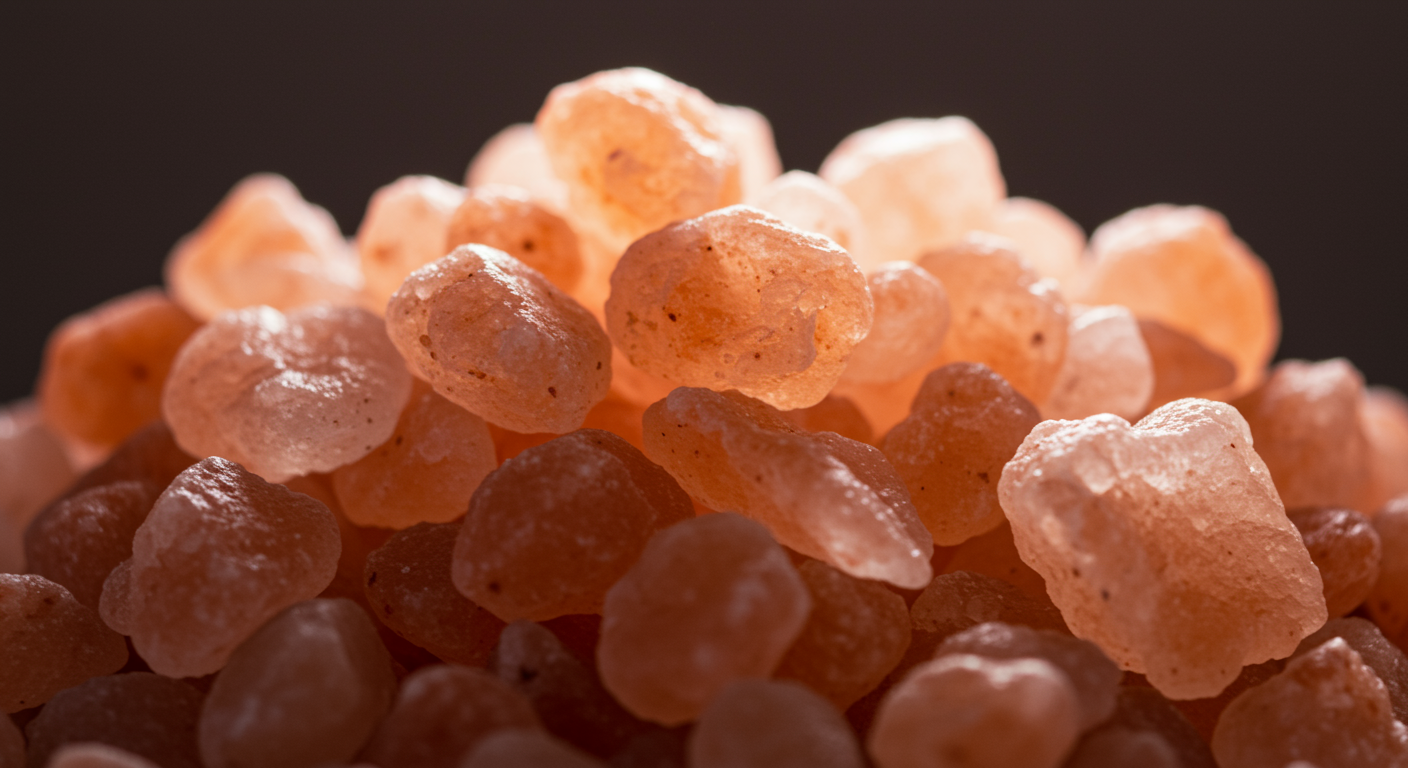

TL; DR: Himalayan pink salt gets its colour from naturally occurring iron oxide and trace minerals trapped in ancient salt deposits in Pakistan. While it offers a subtle flavour and visual appeal, its health benefits over regular salt are often overstated.
Have you picked up a jar of pink salt and thought for a second why Himalayan salt is pink? The colour catches your eye, but there’s a long and fascinating story behind it. Old oceans dried up long ago and left salt with minerals that made it pink. In this article, we’ll look at the science behind it and why so many people enjoy using it, so you can decide for yourself if it’s worth the hype.
What makes this salt stand out? Himalayan pink salt is a natural ingredient known for its rosy color and mineral-rich flavour that enhances everyday cooking. It comes from deep mines and keeps natural minerals that table salt does not hold. But is it better for you? Let’s separate real science from common myths. By the end, you can decide if you want to try it.
What You Will Learn in This Post
- The real reason for the pink color.
- Where the salt comes from and how miners get it.
- Truth about its minerals and health claims.
- Tips to pick the best kind.
The Geological Origin of Himalayan Pink Salt
More than 250 million years ago, a shallow sea covered what is now northern Pakistan. Over millions of years, the climate changed, the water evaporated, and thick layers of salt were left behind. Dust, clay, and tiny mineral particles from the surrounding land mixed into those layers.
That’s the first important point: the pink colour was already being “painted” while the salt was still forming.
Millions of years later, deep underground, those salt layers were buried under enormous pressure and slowly turned into solid rock salt.
Out of all the minerals trapped inside the salt crystals, one plays the biggest role: iron oxide, which is essentially natural rust.
Even though iron oxide is present in only very small amounts, usually 40–65 milligrams per kilogram, it is enough to give the salt its characteristic pink to reddish hue.
It’s like adding just one drop of red food colouring to a glass of water; you don’t need much to change how it looks.
Other minerals like magnesium, calcium, potassium, manganese, and zinc are also present and sometimes slightly modify the shade, but iron oxide is the main artist responsible for the pink colour most people recognise.
Why Some Crystals Are Almost White?
If you look closely at a bag of Himalayan salt, you’ll notice the colour isn’t completely even.
- Almost white crystals → very low iron oxide content
- Soft baby pink → moderate iron oxide
- Deep pink to brick red → higher iron oxide concentration
This variation happens because mineral content was never perfectly uniform across the ancient seabed. Different layers and pockets have slightly different chemistry. Miners simply bring up whatever nature left behind.
Is It Dyed? The Question Everyone Asks
No, authentic Himalayan pink salt is not dyed since the colour is a natural result of the iron oxide and multiple trace minerals that have been locked inside the crystals for hundreds of millions of years.
However, real salt usually shows uneven colouring within individual crystals, like something artificial dye rarely mimics perfectly. That’s why it is important to check and research everything, since cheap counterfeit products sometimes do get dyed, which is why buying from reputable suppliers matters to get a reliable and natural product. To learn more about responsibly sourced Himalayan pink salt, visit: https://www.ittefaqsalt.com/uk/.
Why Do We Call It “Himalayan”?
Here comes the small surprise, which is that almost all true Himalayan pink salt is not mined in the Himalaya mountains.
The vast majority comes from one single location, the Salt Ranges located in the Punjab, Pakistan, about 200–250 km south of the main Himalayan range.
The name “Himalayan” was chosen mainly for marketing reasons like it sounds pure, ancient and exotic.
“84 Minerals” What’s the Real Story?
You have probably seen the claim that “Himalayan salt contains 84 minerals and trace elements. The number is roughly correct; laboratory analyses usually detect between 80 and 85 different elements. However, most of them are present in extremely tiny amounts:
|
Mineral |
Approximate amount per 1 kg |
% of daily need (in 1 tsp / 5 g) |
|
Iron |
40–65 mg |
2–4 % |
|
Calcium |
2 000–4 000 mg |
1 % |
|
Magnesium |
2 000–4 000 mg |
2–3 % |
|
Potassium |
2 000–3 500 mg |
2–3 % |
|
Zinc, Copper, etc. |
< 10 mg |
<< 1 % |
Although some minerals appear in gram-level amounts per kilogram, a typical serving of salt (about 1 teaspoon or 5 g) provides only very small fractions of daily mineral requirements.
While the diversity of minerals is impressive from a geological standpoint, their nutritional impact in everyday use is minimal.
Is It Actually Better for Your Health?
There is no clear evidence that shows it is significantly healthier than regular table salt when used in normal cooking amounts.
What you get:
- Mild, Subtle salty flavour because of the trace minerals
- No added anti-caking agents if you buy unrefined
- Pleasant pink colour for finishing dishes
What you don’t get:
- Lower sodium content since it has almost the same amount of sodium as table salt
- Significant amounts of minerals that move the needle nutritionally
- Added iodine; most table salt is iodised; Himalayan salt usually is not.
Where Does the Best Salt Come From?
Today, most of the authentic pink salt sold worldwide comes from ancient salt deposits located in the foothills of the Himalayas. Manufacturers such as Ittefaq Salt Pakistan source Himalayan pink salt from these regions to ensure authenticity and responsible sourcing.
Final Thought
Next time you reach for that pink salt grinder, know that you are holding something quite special, a small piece of an ancient salt, known for its famous pink color over hundreds of millions of years. It is beautiful on the plate, adds a subtle depth to flavour, and brings a quiet sense of history to every dish.
For those who value authenticity and natural sourcing, choosing authentic Himalayan pink salt from trusted suppliers helps ensure quality and consistency.

