

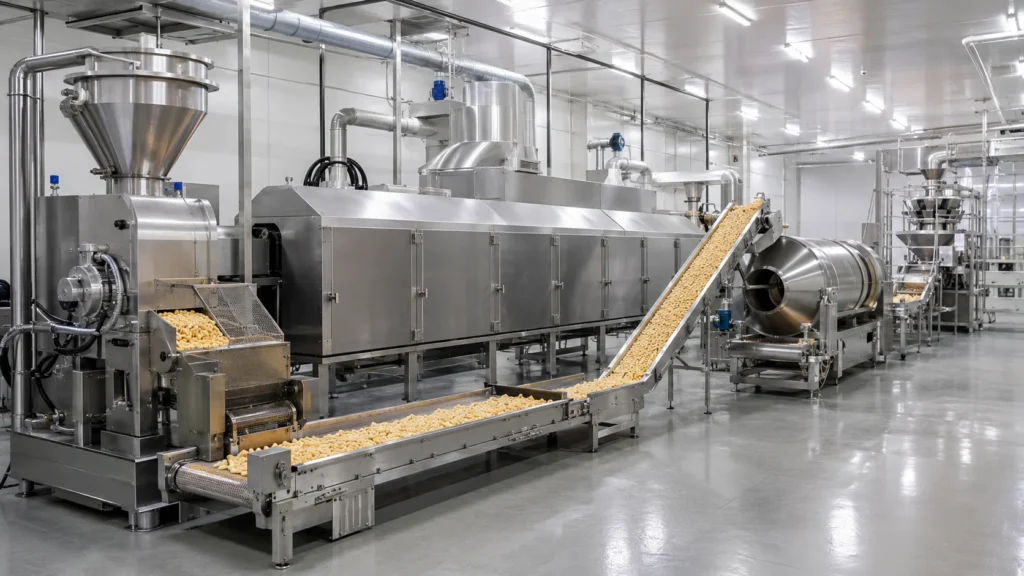

Artificial intelligence is moving from the technology lab onto the factory floor, but the reality of AI in UK food manufacturing is more practical — and less dramatic — than many headlines suggest.
Food manufacturers are using AI to analyse production data, monitor machinery, support quality control, improve forecasting, reduce waste and make operational decisions faster. At the same time, many businesses are still working out how to connect AI to older equipment, fragmented data and existing manufacturing systems.
That matters because food and drink manufacturing is one of Britain’s largest industrial sectors. Defra data puts the sector’s gross value added at £39.3 billion in 2024, while food remained the largest division of UK manufacturing by product sales in 2025.
The central question in 2026 is therefore no longer whether AI could be useful to food manufacturers.
It is where AI is already delivering value, where adoption remains experimental and whether manufacturers can turn investment into measurable improvements.
Key Facts
| Issue | What the evidence shows |
|---|---|
| AI adoption | Adoption is increasing, but many manufacturers remain at an early stage |
| Predictive maintenance | One of the clearest practical applications |
| Quality control | Computer vision and machine learning can support inspection and anomaly detection |
| Forecasting | AI can analyse demand, production and supply-chain information |
| Food waste | AI is being tested to identify and reduce manufacturing waste |
| Food safety | The FSA is examining AI for assurance, risk assessment and compliance |
| Main barriers | Data quality, legacy systems, skills, integration and operational complexity |
| Human role | AI is primarily being positioned as decision support rather than a replacement for accountable people |
Table of Contents
- Why AI matters to UK food manufacturing
- How much AI are UK food manufacturers actually using?
- 1. Predictive maintenance
- 2. AI quality control
- 3. Production optimisation
- 4. Demand and supply forecasting
- 5. Reducing food waste
- 6. Food safety and compliance
- 7. What UK manufacturers are learning
- Why AI adoption remains difficult
- Will AI replace food manufacturing workers?
- What happens next?
- Key Takeaways
Why AI Matters to UK Food Manufacturing
Food manufacturing operates under unusual pressure.
Factories have to manage ingredients, energy, machinery, labour, food safety, quality, packaging, logistics and retailer requirements while maintaining consistent output.
Small inefficiencies can therefore become expensive.
A production line that stops unexpectedly can create lost output. A quality problem can lead to rejected products. Poor forecasting can contribute to excess inventory or shortages. Inefficient processes can increase energy use and food waste.
AI is attractive because it can process large quantities of operational information and identify patterns that would be difficult to detect manually.
But AI does not automatically solve those problems.
The quality of the data, the reliability of the underlying systems and the way employees act on the information can be just as important as the AI model itself.
How Much AI Are UK Food Manufacturers Actually Using?
The evidence points to a sector that is moving forward but is still some distance from universal adoption.
Research published by Food Manufacture in partnership with Barclays in 2026 found that AI adoption across food and drink manufacturing was still at an early stage for many businesses, even though investment intentions were increasing.
The same research identified fragmented data, forecasting difficulties and operational complexity among the challenges manufacturers need to overcome.
That distinction is important.
AI is no longer simply a futuristic concept for food factories.
But neither is it accurate to suggest that most UK food manufacturing plants have become fully autonomous AI factories.
The current reality sits between those two extremes.
Manufacturers are increasingly experimenting with targeted applications where the business problem is clear.
1. Predictive Maintenance
Predictive maintenance is one of the clearest examples of AI moving from theory into practical manufacturing.
Traditional maintenance often follows a schedule.
A machine may be inspected after a certain number of operating hours or replaced according to a planned timetable.
AI-supported maintenance can take a different approach.
Machine-learning systems can analyse equipment data and look for changes that could indicate developing faults.
The objective is not simply to predict a failure.
The real business objective is to give engineers enough warning to intervene before a failure causes a major production interruption.
Hovis provides a UK example
Hovis has expanded its relationship with UK industrial AI company IntelliAM, deploying AI and smart-sensor technology across multiple manufacturing sites.
The technology is focused on equipment reliability, condition monitoring and maintenance decision-making.
The example illustrates an important point about industrial AI.
The system does not remove engineers from the process.
Instead, it provides engineers with additional information about what may be happening inside equipment.
That can allow maintenance teams to investigate developing problems before they become major breakdowns.
For food manufacturers operating expensive production lines, avoiding even a small number of serious stoppages can make targeted AI investment commercially attractive.
2. AI Quality Control
Quality control is another major opportunity.
Food factories already perform extensive inspections.
The challenge is that human inspection can be difficult to maintain consistently at high production speeds.
Computer vision can analyse images of products or packaging and identify patterns associated with defects, incorrect presentation or other quality issues.
Machine-learning systems can also compare production data and identify unusual patterns.
Potential applications include:
- product inspection
- packaging checks
- size and shape classification
- foreign-object detection
- defect identification
- process monitoring
- anomaly detection
- documentation checks
The important distinction is that AI-supported quality control does not automatically mean replacing quality professionals.
In many applications, AI can act as another layer of inspection or prioritisation.
Human experts remain responsible for understanding the context and deciding what action should follow.
3. Production Optimisation
Food production involves thousands of variables.
Ingredient characteristics can change.
Temperature can change.
Equipment performance can change.
Demand can change.
Production schedules can change.
AI can potentially analyse these variables together.
For example, a manufacturer could use machine-learning models to identify relationships between production conditions and output quality.
The result could be better scheduling, fewer process deviations or more efficient use of production capacity.
The FSA’s research into AI in the UK food system identified production and processing as areas where AI has potential, including quality control, sorting and production optimisation.
However, the evidence base for large-scale UK implementation remains more limited than the technology industry’s marketing sometimes suggests.
That is why manufacturers need to distinguish between a successful demonstration and a system that works reliably across multiple production sites.
4. Demand and Supply Forecasting
Forecasting is particularly important for food businesses because many products have limited shelf lives.
Manufacturers have to balance several competing risks.
Produce too much and waste increases.
Produce too little and products may become unavailable.
Order too much raw material and working capital is tied up.
Order too little and production can be disrupted.
AI can analyse historical sales, production information and other relevant variables to support forecasting.
Large food manufacturers are already using AI and advanced analytics for demand and supply planning.
Nestlé, for example, has described AI as part of its wider manufacturing and supply-chain operations, including forecasting and scenario analysis.
The value here is not that AI can perfectly predict the future.
It cannot.
The value is that models can process more information and identify relationships that may help planners make better decisions.
5. Reducing Food Waste
Food waste is another major opportunity.
UK food manufacturers generated around 1.4 million tonnes of food waste in 2021, according to the figure cited by Nestlé in its 2026 AI project announcement.
Nestlé and partners have been testing AI-led technology designed to help manufacturers identify food waste, reduce it and redistribute unavoidable surplus.
The project illustrates another important AI use case.
The technology does not necessarily need to invent a new manufacturing process.
It can instead improve visibility.
If a factory can identify where material is being lost, when losses are occurring and which processes are responsible, managers can investigate the cause.
That could lead to changes in production planning, inventory management or process control.
AI therefore becomes part of a wider continuous-improvement system.
6. Food Safety and Compliance
Food safety is where AI becomes particularly sensitive.
The Food Standards Agency has formally examined the potential use of AI in food safety and authenticity.
Its Science Council considered applications including AI-driven safety and regulatory-compliance evaluation for manufactured foods.
Potential applications include:
- identifying unusual patterns
- analysing food-safety information
- supporting risk assessment
- checking documentation
- assisting assurance processes
- analysing incident information
- supporting food authenticity work
- prioritising risks
The FSA’s research also makes an important point about accountability.
AI should support decision-making rather than become an unaccountable replacement for human responsibility.
That principle is particularly important in food manufacturing because safety decisions can affect consumers directly.
AI cannot replace food-safety responsibility
A manufacturer cannot simply blame an algorithm when something goes wrong.
Businesses still need appropriate food-safety systems, competent staff, documented procedures and effective controls.
AI can make those systems more data-driven.
It cannot remove the underlying responsibility.
7. What UK Manufacturers Are Learning
One of the clearest lessons from current projects is that AI works best when it is connected to a specific operational problem.
A factory does not necessarily need an AI system because AI is fashionable.
It may need better:
- maintenance decisions
- forecasting
- quality inspection
- production planning
- waste monitoring
- energy management
- supply-chain visibility
- food-safety analysis
The technology should follow the problem.
This is particularly important for smaller manufacturers.
The UK food and drink manufacturing sector contains thousands of small and medium-sized businesses.
Government data shows that SMEs account for the overwhelming majority of food and drink manufacturing businesses.
That makes a simple copy-and-paste approach to AI unlikely to work.
A multinational manufacturer with sophisticated manufacturing execution systems has very different resources from a small regional producer.
Why AI Adoption Remains Difficult
Data quality
AI needs data.
But data can be incomplete, inconsistent or stored in incompatible systems.
A factory may have information spread across:
- production systems
- maintenance software
- spreadsheets
- sensors
- laboratory records
- enterprise resource planning systems
- quality systems
Connecting those sources can be harder than selecting an AI model.
Legacy equipment
Many food factories operate machinery that was installed years or decades ago.
Modern AI systems may need additional sensors or integration layers before they can use data from that equipment.
Skills
AI adoption requires more than software.
Manufacturers need people who understand both the technology and the production environment.
That can include engineers, data specialists, IT teams, food technologists, quality professionals and operations managers.
Cost
An AI pilot may be relatively inexpensive.
Scaling the system across multiple factories can be much more expensive.
The business case therefore needs to account for integration, sensors, data infrastructure, training, maintenance and ongoing support.
Operational complexity
A model that performs well in one controlled environment may behave differently at another site.
Different equipment, ingredients, production schedules and operating practices can change the data.
This is one reason the move from pilot to production remains one of the biggest challenges for industrial AI.
Will AI Replace Food Manufacturing Workers?
The evidence does not support a simple conclusion that AI will eliminate food manufacturing jobs.
The more immediate change is likely to involve the tasks workers perform.
AI can take on parts of information processing, monitoring and analysis.
That can allow employees to spend more time on:
- problem-solving
- engineering decisions
- process improvement
- quality investigations
- maintenance
- supervision
- exception handling
At the same time, some repetitive tasks may become increasingly automated.
The workforce therefore faces both risks and opportunities.
Manufacturers that introduce AI without training employees may create resistance and underuse the technology.
Manufacturers that involve workers in implementation may be better placed to identify where AI can actually improve operations.
What Happens Next?
The next stage of UK food manufacturing AI is likely to be less about spectacular demonstrations and more about integration.
The important question will be whether manufacturers can connect AI with the systems they already use.
The UK Government’s wider Advanced Manufacturing AI Adoption Plan explicitly identifies the move from pilot projects to sustained industrial deployment as a major challenge.
The FSA is also developing its own use of AI and modern technology for regulatory intelligence, risk assessment and food-incident management.
That means AI is likely to influence both sides of the food-safety relationship.
Manufacturers may use AI internally.
Regulators may use AI to analyse food-system information.
The interaction between those systems will create new questions around data quality, validation, transparency, cybersecurity and accountability.
Is AI the Future of UK Food Manufacturing?
AI is likely to become an increasingly important part of UK food manufacturing, but the transformation will probably be gradual.
The strongest applications are not necessarily the most futuristic ones.
Predicting a machine failure before it stops a production line can be more valuable than deploying a sophisticated chatbot.
Detecting a quality problem earlier can be more valuable than generating a marketing campaign.
Finding the source of food waste can be more valuable than producing another experimental AI application.
The evidence from 2026 suggests that AI is becoming a practical manufacturing technology.
But the companies most likely to benefit will not necessarily be those that buy the most AI.
They will be those that identify the right operational problems, prepare their data, involve their workforce and measure whether the technology actually improves performance.
For Britain’s food manufacturers, the AI race is therefore becoming less about experimentation and more about execution.
Key Takeaways
- AI is moving into practical UK food manufacturing applications.
- Adoption remains uneven and is still at an early stage for many manufacturers.
- Predictive maintenance is one of the clearest factory-floor applications.
- AI can support quality inspection and anomaly detection.
- Forecasting is another important application because food businesses must balance supply, demand and waste.
- AI is being tested to help identify and reduce food manufacturing waste.
- The Food Standards Agency is examining AI for food safety, authenticity and assurance.
- Human accountability remains essential when AI is used in safety-critical decisions.
- Data fragmentation is one of the biggest barriers to successful AI deployment.
- Legacy machinery can make integration difficult.
- Smaller manufacturers face different adoption challenges from multinational businesses.
- AI is more likely to change many food manufacturing tasks than simply eliminate the workforce.
- The next challenge is scaling AI from individual pilots into reliable production systems.
- The most valuable AI projects will be tied to measurable operational problems.
Conclusion
AI is already entering Britain’s food factories, but the 2026 picture is more nuanced than the phrase “AI-powered food manufacturing” suggests.
The technology is being applied to predictive maintenance, quality control, forecasting, waste reduction and food-safety analysis.
Some deployments are already operating across multiple sites. Others remain pilots or emerging applications.
The biggest obstacle is increasingly not access to AI itself.
It is the ability to connect AI to reliable data, existing equipment, skilled employees and real operational decisions.
That may determine the next phase of Britain’s food-manufacturing technology story.
The winners are unlikely to be the companies with the most fashionable AI systems.
They are more likely to be the manufacturers that can turn better data into better decisions — consistently, safely and at scale.
FAQ
1. How is AI being used in UK food manufacturing?
AI is being used for predictive maintenance, quality control, forecasting, production optimisation, waste reduction and operational decision support.
2. Are UK food manufacturers already using AI?
Yes. AI deployments and pilots exist across UK food manufacturing, although adoption remains uneven and many businesses are still at an early stage.
3. What is the biggest use of AI in food manufacturing?
There is no single universal use case. Predictive maintenance, quality control, forecasting and production optimisation are among the most relevant applications.
4. Can AI reduce food waste?
Potentially. AI can help manufacturers identify patterns in production, inventory and operational data that may reveal where food losses occur.
5. Can AI predict machinery failures?
AI-supported predictive maintenance can analyse equipment data for patterns associated with developing faults and help engineers intervene before a breakdown.
6. Will AI replace food manufacturing workers?
AI is more likely to automate or assist particular tasks than eliminate food manufacturing employment altogether. Workforce effects will vary by role and application.
7. What is stopping UK food manufacturers adopting AI?
Important barriers include fragmented data, legacy equipment, integration costs, skills shortages, operational complexity and uncertainty over the business case.
8. Can AI improve food safety?
AI can support risk analysis, quality control, surveillance, documentation and assurance. However, human accountability and appropriate food-safety controls remain essential.
9. Are small UK food manufacturers using AI?
Some are experimenting with AI, but smaller manufacturers generally face greater constraints around investment, skills, data and technology integration.
10. What is the future of AI in UK food manufacturing?
The next stage is likely to focus on connecting AI to existing manufacturing systems and scaling successful pilots into reliable production applications.

